sábado, 2 de fevereiro de 2013
sexta-feira, 1 de fevereiro de 2013
Pelo Dia dos Namorados participe no Concurso de Textos de Amor Manuel A. Pina
O Museu Nacional da Imprensa
promove, a
partir do dia
11 de
Fevereiro, o
Concurso de
Textos de Amor
Manuel A.
Pina, em
homenagem ao
jornalista e
escritor
falecido em
outubro de
2012. A
iniciativa,
especial para
o Dia dos
Namorados,
prolonga-se
até 17 de
Fevereiro, em
busca de
textos de amor
originais.
Dirigido aos apaixonados de todas as idades e residentes em qualquer parte do país (e a portugueses no estrangeiro), o concurso, já na 13ª edição, vai premiar os melhores textos concorrentes, em poesia ou prosa.
Os prémios principais são uma viagem de avião (destino Europa) e um cruzeiro no Douro para duas pessoas, além de livros e cd-roms.
O Museu Nacional da Imprensa pretende, com esta iniciativa, motivar a emergência de novos autores, apelando à escrita de textos de carácter amoroso.
Durante a “semana dos namorados”, o museu está aberto à recepção de textos originais alusivos ao amor e os visitantes poderão imprimir poemas de diversos autores (Camões, Florbela Espanca, Bocage, Pessoa, Eugénio de Andrade…), nos prelos-relíquia do Museu.
Os textos concorrentes devem ser registados num impresso próprio, disponível nas instalações daquele Museu e no seu sítio oficial (www.museudaimprensa.pt) onde está patente o regulamento.
Dirigido aos apaixonados de todas as idades e residentes em qualquer parte do país (e a portugueses no estrangeiro), o concurso, já na 13ª edição, vai premiar os melhores textos concorrentes, em poesia ou prosa.
Os prémios principais são uma viagem de avião (destino Europa) e um cruzeiro no Douro para duas pessoas, além de livros e cd-roms.
O Museu Nacional da Imprensa pretende, com esta iniciativa, motivar a emergência de novos autores, apelando à escrita de textos de carácter amoroso.
Durante a “semana dos namorados”, o museu está aberto à recepção de textos originais alusivos ao amor e os visitantes poderão imprimir poemas de diversos autores (Camões, Florbela Espanca, Bocage, Pessoa, Eugénio de Andrade…), nos prelos-relíquia do Museu.
Os textos concorrentes devem ser registados num impresso próprio, disponível nas instalações daquele Museu e no seu sítio oficial (www.museudaimprensa.pt) onde está patente o regulamento.
quinta-feira, 31 de janeiro de 2013
quarta-feira, 30 de janeiro de 2013
O fétiche por imagens de livros na internet / The fetish of book images on the internet
Eu pertenço a este clube! :)
Face Out: The Curious Rise of Bibliographics
Suzy Staubach
Face Out: The Curious Rise of Bibliographics
Suzy Staubach
What does the proliferation of sites, books, and blogs celebrating
images of books say about our relationship with the printed word?
While we debate whether reading a book printed on paper or via an e-reader is preferable, a fetish of book images has emerged here in the U.S. and in Europe, manifesting itself both online and in print books themselves. It has permeated Facebook, Pinterest, Tumblr, and beyond.
There is clearly a deep and widespread fascination with these images, representations of books, mirrors that cannot themselves be read. I admit that I’ve been pulled in, fascinated, looking, posting, but I still wonder what it signifies.
First, let’s take a quick tour.
The web site My Ideal Bookshelf (www.myidealbookshelf.com), which is also a book, features paintings of book spines by Jane Mount. The artist says she “paints portraits of people through the spines of books,” believing the books a person chooses to display tell a lot about him or her. On the site, you can commission an original painting by Mount in gouache on fine watercolor paper, framed or unframed, of your own favorite books. You can also order a painting for a friend or order notecards and prints of her earlier bookshelf portraits.
The companion book, My Ideal Bookshelf (9780316200905), features Mount’s paintings of the spines of books selected by dozens of well-known writers, such as Michael Chabon and Jennifer Eagan. The bright paintings, one shelf for each author, with a row of books against a white background, are an intimate peek at writers’ reading habits. Looking at Mount’s art, I found myself wanting a painting of my books too, although my house is awash in books.
Bookshelf (9780500516140) by Alex Johnson showcases modern and highly original bookshelves. There are “library” shelves that look like buildings and “pallet” shelves that look like, well, pallets, and shelves made of stainless steel or polyurethane. This is a heavily illustrated book, ostensibly for sophisticated designers who, as a professional matter, use books as presentation. Again, this is about images.
And then there’s Bookshelf Porn. In January 2009, Anthony Dever created his visual blog (http://bookshelfporn.com) using Tumblr “to allow people to indulge their love of books, libraries, bookstores, and bookcases by showcasing the best bookshelf photos from around the world.”
I think the notion of equating looking at and lusting after beautiful bookshelves filled with books with pornography is a keen insight into the increasing popularity of images of books and bookish things. Have books become objects of desire or is it the representation of books that is desired? Bookshelf Porn also has a strong presence on Facebook and Pinterest and was chosen by Time magazine as one of the 25 best blogs of 2012. The blog’s Facebook page has more than 52,000 likes—that’s 52,000 people looking at Facebook posts of bibliographics every day, often several times a day.
The Book Riot web site (http://bookriot.com) is devoted to lists and recommendations of books to read. Its Facebook page (www.facebook.com/BookRiot?fref=ts), however, is intensely visual, with frequent posts of images and quotes about books, reading, bookstores, and bookshelves. The posts are so good, it’s tempting to share all of them on your own or your bookstore’s page. Based in Brooklyn, Book Riot has a staff and attracts advertising. Its Facebook page boasts almost 33,000 likes.
Pinterest is a feast of book visuals, with many boards and pinners devoted to images of bookstores, libraries, books in art, quotes about books, bookshelves, other things made to look like books, people reading, and on and on. For starters, there’s Book Patrol, Book Expo, Bibliophilia, ABA, and many bookstore pinners focusing on book images as well as individuals with boards devoted to book images. I’m not talking about book-cover pins, which are essentially promotional, but delicious photos of books in every guise.
Tattered Cover has close to 3,000 followers of its many images on Pinterest. Why are all these people looking at pictures of benches made to look like books, earrings in the shape of books, cozy booklined rooms, bookmobiles, Middle Eastern bookstalls, and more?
Two recent illustrated books for people who love ogling images of beautiful rooms filled with books are Living with Books (9780500290309) by Dominique Dupuich and Roland Beaufre and Books Make a Home (9781849751872) by Damian Thompson. These are dream-books for those of us who don’t have houses large enough for separate library rooms or the funds to purchase all the books we would like to own.
Dreaming may explain the astonishing proliferation of book and book-related images and the many people flocking to them. I wonder if the images are a fantasy fulfillment of our desires. Are they salve for the unconscious fears that lurk in our reader souls as we spend our frantic days working in an increasingly technological world? Is it easier, less time-consuming in our time-pressed days, to feel admirably bookish by looking at these images rather than by actually reading? Are the people looking at and sharing and posting these images just book people looking for one more literary high? Is it a fad?
It’s certainly interesting that the surge of bibliographics coincides with the rise of e-books and the Internet. They are a different flavor of virtual.
As perplexed as I am about how to interpret what this means for our culture as a whole, neither do I know what it means for the physical books on our bookstore shelves or the e-books on our web sites. However, there is no question that representations of books are capturing the imaginations of many.
Whatever the meaning, as an extension of the book culture in which we already participate as purveyors of books, we cannot let ourselves be left behind. Perhaps it’s time to join the cult of bibliographics ourselves?
While we debate whether reading a book printed on paper or via an e-reader is preferable, a fetish of book images has emerged here in the U.S. and in Europe, manifesting itself both online and in print books themselves. It has permeated Facebook, Pinterest, Tumblr, and beyond.
There is clearly a deep and widespread fascination with these images, representations of books, mirrors that cannot themselves be read. I admit that I’ve been pulled in, fascinated, looking, posting, but I still wonder what it signifies.
First, let’s take a quick tour.
The web site My Ideal Bookshelf (www.myidealbookshelf.com), which is also a book, features paintings of book spines by Jane Mount. The artist says she “paints portraits of people through the spines of books,” believing the books a person chooses to display tell a lot about him or her. On the site, you can commission an original painting by Mount in gouache on fine watercolor paper, framed or unframed, of your own favorite books. You can also order a painting for a friend or order notecards and prints of her earlier bookshelf portraits.
The companion book, My Ideal Bookshelf (9780316200905), features Mount’s paintings of the spines of books selected by dozens of well-known writers, such as Michael Chabon and Jennifer Eagan. The bright paintings, one shelf for each author, with a row of books against a white background, are an intimate peek at writers’ reading habits. Looking at Mount’s art, I found myself wanting a painting of my books too, although my house is awash in books.
Bookshelf (9780500516140) by Alex Johnson showcases modern and highly original bookshelves. There are “library” shelves that look like buildings and “pallet” shelves that look like, well, pallets, and shelves made of stainless steel or polyurethane. This is a heavily illustrated book, ostensibly for sophisticated designers who, as a professional matter, use books as presentation. Again, this is about images.
And then there’s Bookshelf Porn. In January 2009, Anthony Dever created his visual blog (http://bookshelfporn.com) using Tumblr “to allow people to indulge their love of books, libraries, bookstores, and bookcases by showcasing the best bookshelf photos from around the world.”
I think the notion of equating looking at and lusting after beautiful bookshelves filled with books with pornography is a keen insight into the increasing popularity of images of books and bookish things. Have books become objects of desire or is it the representation of books that is desired? Bookshelf Porn also has a strong presence on Facebook and Pinterest and was chosen by Time magazine as one of the 25 best blogs of 2012. The blog’s Facebook page has more than 52,000 likes—that’s 52,000 people looking at Facebook posts of bibliographics every day, often several times a day.
The Book Riot web site (http://bookriot.com) is devoted to lists and recommendations of books to read. Its Facebook page (www.facebook.com/BookRiot?fref=ts), however, is intensely visual, with frequent posts of images and quotes about books, reading, bookstores, and bookshelves. The posts are so good, it’s tempting to share all of them on your own or your bookstore’s page. Based in Brooklyn, Book Riot has a staff and attracts advertising. Its Facebook page boasts almost 33,000 likes.
Pinterest is a feast of book visuals, with many boards and pinners devoted to images of bookstores, libraries, books in art, quotes about books, bookshelves, other things made to look like books, people reading, and on and on. For starters, there’s Book Patrol, Book Expo, Bibliophilia, ABA, and many bookstore pinners focusing on book images as well as individuals with boards devoted to book images. I’m not talking about book-cover pins, which are essentially promotional, but delicious photos of books in every guise.
Tattered Cover has close to 3,000 followers of its many images on Pinterest. Why are all these people looking at pictures of benches made to look like books, earrings in the shape of books, cozy booklined rooms, bookmobiles, Middle Eastern bookstalls, and more?
Two recent illustrated books for people who love ogling images of beautiful rooms filled with books are Living with Books (9780500290309) by Dominique Dupuich and Roland Beaufre and Books Make a Home (9781849751872) by Damian Thompson. These are dream-books for those of us who don’t have houses large enough for separate library rooms or the funds to purchase all the books we would like to own.
Dreaming may explain the astonishing proliferation of book and book-related images and the many people flocking to them. I wonder if the images are a fantasy fulfillment of our desires. Are they salve for the unconscious fears that lurk in our reader souls as we spend our frantic days working in an increasingly technological world? Is it easier, less time-consuming in our time-pressed days, to feel admirably bookish by looking at these images rather than by actually reading? Are the people looking at and sharing and posting these images just book people looking for one more literary high? Is it a fad?
It’s certainly interesting that the surge of bibliographics coincides with the rise of e-books and the Internet. They are a different flavor of virtual.
As perplexed as I am about how to interpret what this means for our culture as a whole, neither do I know what it means for the physical books on our bookstore shelves or the e-books on our web sites. However, there is no question that representations of books are capturing the imaginations of many.
Whatever the meaning, as an extension of the book culture in which we already participate as purveyors of books, we cannot let ourselves be left behind. Perhaps it’s time to join the cult of bibliographics ourselves?
http://onlinedigitalpublishing.com/article/Face+Out%3A+The+Curious+Rise+of+Bibliographics/1281715/0/article.html
terça-feira, 29 de janeiro de 2013
segunda-feira, 28 de janeiro de 2013
domingo, 27 de janeiro de 2013
sábado, 26 de janeiro de 2013
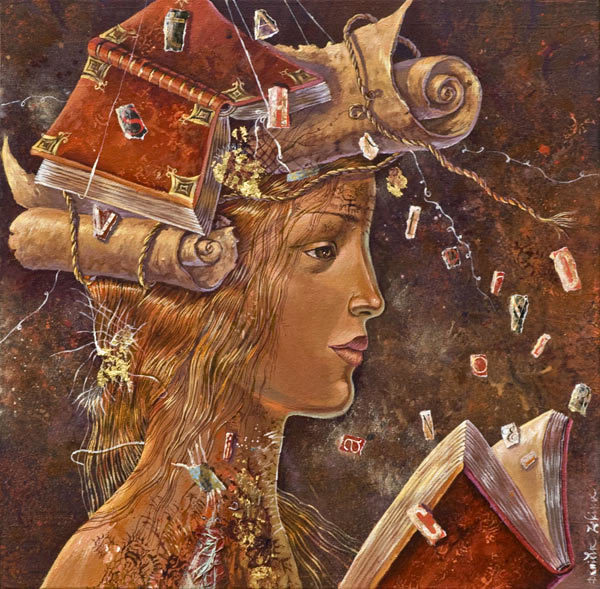
As leitoras de Daniela Zekina e uma citação / Women reading by Daniela Zekina and a quote
"Open a book this minute and start reading. Don’t move until you’ve
reached page fifty. Until you’ve buried your thoughts in print. Cover
yourself with words. Wash yourself away... Dissolve"
Carol Shields
sexta-feira, 25 de janeiro de 2013
quinta-feira, 24 de janeiro de 2013
quarta-feira, 23 de janeiro de 2013
terça-feira, 22 de janeiro de 2013
Guia para bibliotecários sobre as leis dos Direitos de Autor / "Copyright for Librarians: the essential handbook"
"Copyright for Librarians: the essential handbook" é uma publicação conjunta da Harvard’s Berkman Center for Internet and Society e da EIFL (Electronic Information for Libraries) sobre as leis dos Direitos de Autor:
"Copyright for Librarians" (CFL) is an online open curriculum on
copyright law that was developed jointly with Harvard’s Berkman Center
for Internet and Society.
Re-designed as a brand new textbook, "Copyright for Librarians: the essential handbook"
can be used as a stand-alone resource or as an adjunct to the online
version which contains additional links and references for students who
wish to pursue any topic in greater depth.
Delve into copyright theory or explore enforcement. With a new index and a handy Glossary, the
Handbook is essential reading for librarians who want to hone their
skills in 2013, and for anyone learning about or teaching copyright law
in the information field.
“...What makes this volume so special – and so uniquely valuable –
is that it puts reliable guidance in the framework of a broader
analysis of copyright policy, focusing attention on the role that
librarians can play. As the book makes clear, library patrons benefit
from national laws that balance protection and access, and librarians
can help assure that their own national legislation fits this
description. This is a book that everyone concerned with the future of
libraries everywhere will want to consult again and again in the years
to come.”
Peter Jaszi, Professor of Law, American University Law School
Está disponível para download AQUI.
"Vale a pena ler um livro": electrónico ou em papel?
Aqui fica um artigo de opinião de Luís D. Patrício sobre as diferenças entre o livro digital e o livro em papel:
"O audiovisual continua a alastrar a sua intervenção e com a sua
enorme capacidade sedutora continua a chegar a muitos cidadãos. De entre
os diversos conteúdos acessíveis no moderno audiovisual podemos
destacar o livro eletrónico, uma novidade que vai naturalmente ganhando
novos adeptos.
Mas sabemos como o mundo da eletrónica evolui vertiginosamente.
Rapidamente
um utensílio fica desatualizado, passa de moda, sendo colocado
facilmente de lado pelo utilizador que ambiciona manipular o que surge
de mais recente, utilizar o mais moderno. Mesmo reconhecendo-se que um
utensílio tem validade, troca-se por já não oferecer o estímulo da
novidade.
Um livro eletrónico, apaga-se ou então, qual ficheiro colecionável, arquiva-se num local como grão de areia.
Mas um livro de papel…
Vale a pena ler um livro, folheá-lo, é uma relação mais quentinha.
Na
montra ou no expositor dá-nos uma imagem e quando lhe pegamos tem um
volume que se sente facilmente a três dimensões; tem uma capa e uma
contracapa, dura ou mole, tem um odor, porventura um cheiro a novo, e
tem um conteúdo que lido e entendido pode acompanhar uma vida.
Um
livro de papel pode passar a fazer parte de quem o lê, das suas
atitudes, dos seus sentimentos e emoções. Pode tornar-se numa companhia
que pelo menos, havendo claridade está sempre disponível para permitir
uma relação de intimidade mais ou menos prolongada com os conteúdos que
estão escritos, e com as mensagens desencadeadas no leitor.
Um
livro é um objeto com história, com um antes, um durante e um depois e
sendo um livro de papel, não passa de moda, porque ao ser lido está na
moda de quem o lê. Oferece materialmente uma estabilidade de relação com
o leitor que é muito mais segura, fiel e palpável do que o virtual.
Um
livro de papel olha-se e vê-se, abre-se e fecha-se, toca-se e sente-se,
no todo ou em parte, ou página a página ou em várias partes.
Sente-se
e pode-se ouvir o virar da página feito com um dedo porventura
humedecido ou feito com vários dedos. E de seguida pode fixar-se a
página virada afagando com os dedos, seja um livro de bolso ou um livro
maior. E se teimosamente insiste em se fechar, com o polegar fazemos a
pressão adequada para que se mantenha o livro aberto.
Um livro de
papel pode-se estimar, há quem forre um determinado livro, quem lhe
ponha uma capa para o proteger. Também se pode sublinhar e há quem o
faça inúmeras vezes, como que a vincar o valor das palavras, a
intensidade do pensamento ali escrito.
Um livro de papel faculta
um sentido de posse, ou da estima, da utilidade, da memória para futuro,
eventualmente reforçada com uma pérola como seja uma dedicatória que
alguém escreveu para transmitir carinho, afeição, muita dedicação ou até
e apenas respeito, de quem assina para quem o recebeu.
Há quem
personalize a sua posse e lá escreva o seu nome e morada, ou quem lhe
coloque um carimbo pessoal, familiar ou institucional.
Um livro para uma criança? Mas isso pode ser um bem extraordinário.
Um dicionário? Que maravilha para a criança passear os seus dedos, olhar, ver e adquirir conhecimento. Que bela pedagogia.
Uma
criança pode colher da leitura de um livro benefícios que não colhe do
ecrã do computador e da Internet, nomeadamente na manipulação das folhas
reais desse objeto porventura facilmente transportável, que pode ser
bastante resistente e bastante seguro, que pode ser sua pertença
juntamente com muitos outros, e que também pode oferecer e trocar.
Tendo
imagens fixas, não emitindo radiações, um livro para uma criança pode
ter conteúdos que estimulam a fantasia, o imaginário, o interesse pelas
histórias, pelo futuro, e que permitem armazenar informação selecionada e
que foi escolhida pelos autores de quem o imaginou e construiu.
Sim,
porque apesar de tudo, a publicação de um livro de papel passa por
diversos intervenientes com critérios, com níveis de responsabilidade e
de saber mais exigentes do que muito do que se pode encontrar no mundo
da Internet.
Em boa verdade o crescente mega mundo universal da
Internet tem outros critérios de publicação e de emissão do que está
disponível. Sendo avassalador o seu imediatismo e poder de atração com
som e imagem de qualidades extraordinárias, exige muito mais atenção e
muitos cuidados perante o acesso de um clique feito por uma criança.
E
a situação pode piorar deveras quando se trata de uma criança
desprevenida e que não esteja acompanhada por quem a respeite, e ajude a
escolher por onde navegar sem lhe provocar algum dano no seu mundo
interno e relacional.
Há que reconhecer que de um modo geral, um
livro de papel foi selecionado e está disponível com outros critérios e
interesses, que podem nada ter a ver com os critérios e interesses de
muitos dos materiais virtuais colocados nas redes/web".
segunda-feira, 21 de janeiro de 2013
Subscrever:
Mensagens (Atom)
+leitora+adormecida.jpg)
+leitora.jpg)
+leitora+adormecida.jpg)

+-+Lawrence+Alma-Tadema+pequenas+leitoras.jpg)
+leitora.jpg)
+leitora.jpg)
+leitora.jpg)

+leitora.jpg)


+leitora.jpg)
+Paul+Hedley.jpg)